CO2 YouTube
How much does watching videos on the internet cost the planet? 🌍
We often hear that it’s a huge energy sink, that it relies on massive servers running nonstop, etc. But is that actually true? 🤔
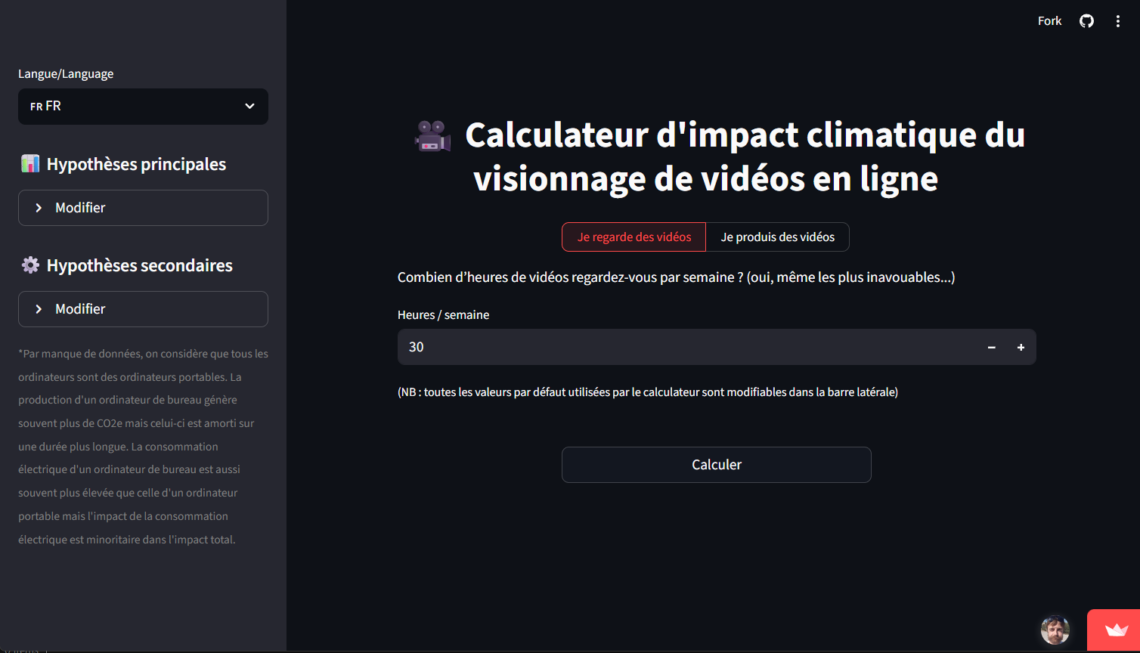
Together with Rodolphe Meyer from the YouTube channel Le Réveilleur, we built a calculator to find out — fully transparent about the calculation method and the data used. It’s super simple, even a geologist could use it: you enter the number of hours of video you watch per week, click Calculate, and boom.
Try the app: https://digitalco2footprint.streamlit.app/
What are the main takeaways?
- For 30 hours of video per week (4–5 hours/day), 57.9 kg of CO₂e are emitted per year. Is that a lot? Not really! To “offset” all those emissions, it would be enough to take the train instead of the plane for a 320 km trip (or replace 54 chicken 🐔 meals with vegetarian meals). And remember that the average carbon footprint of a French person is about 9,000 kg per year. Contrary to popular belief, video streaming is therefore a relatively small source of emissions, especially compared to things like heating or transportation.
- The vast majority of CO₂e linked to video watching comes from manufacturing the devices you use to watch them (smartphone, PC, TV 📱💻, etc.). This has two consequences:
– BY FAR THE BEST WAY TO REDUCE YOUR DIGITAL IMPACT IS TO CHANGE YOUR PHONE, PC, ETC. LESS OFTEN, AND TO BUY FEWER ELECTRONIC DEVICES IN GENERAL (#BlackFriday). Emissions from data centers and networks are an order of magnitude smaller than those from device production.
– If you only look at the marginal impact of watching videos (i.e. how much CO₂ is emitted once you already own the device, ignoring production emissions), streaming emits even less. You go from 57.9 kg down to… 8 kg of CO₂e per year. That could be offset by driving an electric car instead of a combustion engine for… just 70 km. ⚡🚗 - Still aiming to reduce your impact without reducing your consumption, prefer fixed internet connections (Ethernet or Wi-Fi) over mobile networks (4G/5G), since mobile consumes about 20 times more energy per GB transferred.
- But be careful not to increase video resolution when switching to fixed networks (which some apps unfortunately do automatically)! A video watched in 1080p transfers 10 times more data than the same video in 360p (and 360p is MORE than enough to watch most videos on a phone, trust me).
To make the calculator match your actual usage as closely as possible, ALL the parameters used in the calculations (more than 30 of them) are adjustable: how many years you keep your devices, how many hours you spend on each device, etc. For transparency, the source used for the default calculation is also shown (very often the excellent ARCOM report: https://www.arcom.fr/sites/default/files/2024-10/Arcom-arcep-ademe-etude-impact-environnemental-des-usages-audiovisuels.pdf). And since this is a beta and it’s possible we messed something up somewhere (the calculations aren’t trivial), the source code is also available on GitHub: https://github.com/stephanedebove/digital_CO2_footprint. Pull requests welcome! (And you can reuse the calculator framework to build calculators for pretty much anything else.)
Finally, there’s also a mode for video creators who want to know the CO₂e associated with all the hours of video watched on their channel each year… 😈😈
Try the app: https://digitalco2footprint.streamlit.app/
A Le Réveilleur video that goes deeper into the topic:
https://www.youtube.com/watch?v=ln5iQtd7XZI
Source code available on GitHub.